
What a session limit is
A session limit is any pre-committed rule that constrains a single sitting. There are three families: time limits (this session ends at 45 minutes), loss limits (this session ends when net position is minus £25), and behavioural limits (this session ends if I catch myself thinking any of the following). The three overlap in practice, and a functional discipline framework at non gamstop casinos uses all three simultaneously rather than picking one.
The word "pre-committed" is the load-bearing part. A limit set at 45 minutes into a losing session is not a limit — it is a wish. A limit written down at the start of the month, translated onto a phone alarm, and enforced by an automatic external action, is a limit. Every part of the discipline hinges on removing the moment-in-time decision, because moment-in-time decisions are exactly what a well-designed casino session is trying to influence.
Why offshore operators skip enforcement
UKGC-licensed operators are, under the 2023 White Paper reforms and the wider social-responsibility framework, obliged to run reality checks, honour deposit and loss limits with mandated cool-offs on removal, and — since 2020 — participate in the GamStop register. Enforcement is not left to the customer; the licence condition requires the operator to do the work.
Offshore licences differ. The Malta Gaming Authority has meaningful player-protection provisions and, in practice, most MGA brands do offer reality checks, deposit-limit tooling and self-exclusion inside the operator platform. Curaçao GCB tightened its framework materially through the 2023–2024 reforms and now requires more from licensees, but the implementation quality varies from serious brand to token brand. Anjouan Offshore Gaming and smaller offshore jurisdictions typically offer the fewest player-protection features by default.
The consequence, from a session-limit standpoint, is that at non-GamStop operators the enforcement layer sits with you rather than with the operator. Any session limit you set is a promise you are making to yourself with almost no external reinforcement. That does not mean session limits do not work — plenty of adults enforce their own — but it does mean the enforcement has to be built into your setup, deliberately, before any session begins.
There is a second-order point worth noticing here. UKGC-licensed operators have both a commercial incentive to retain customers and a regulatory incentive to protect them; the tension between the two is at least visible in how the market is designed. At non-GamStop operators the regulatory counterweight is much lighter, so the commercial incentive dominates unless something forces the other side of the balance. That "something" is, in practice, the customer's own discipline framework — and if the framework is thin, the balance tilts hard in a direction the customer does not benefit from. Building session rails before the account exists is not paranoia; it is a reasonable response to how the market is actually structured.
Time caps and how to enforce them
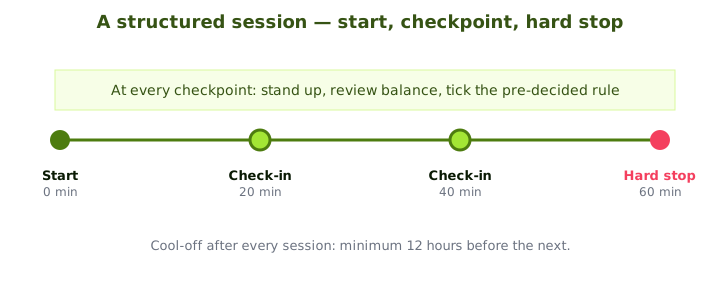
The time cap is the single most under-used discipline in online play. It is also the easiest to enforce, because it is decoupled from the running balance of the session and can be run by any timer. A 45-minute cap set on a phone alarm, labelled clearly, does not care what the account balance says when the alarm goes; it goes at 45 minutes.
Practical time-cap enforcement:
- Decide the cap in advance and write it into a monthly discipline note.
- Set the alarm at the start of the session, in one action, before the first spin.
- Label the alarm "STOP — bankroll" so it is unambiguous.
- Place the phone in another room, on a shelf, or face down out of arm's reach.
- At the alarm: close the browser, log out, stand up, walk away.
- Do not check the account for 12 hours minimum.
- Log the session in the weekly audit.
Time caps work because they are indifferent to how the session is going. A winning session ends at 45 minutes with the same finality as a losing one. That symmetry is important — a cap that only fires on losses is a loss-chasing enabler dressed up as a rule.
Loss caps and hard stops
The loss cap is the net-position rail. It is typically set equal to the session bankroll — the session ends when the pot is empty — and it is a hard stop rather than a soft signal. "Hard stop" means: no top-up, no fresh deposit, no second account, no borrowing from another envelope, no "just one more". The cap fired; the session is over.
Two failure patterns to name explicitly. First, redefining the loss cap mid-session ("well, I brought £30 but I could reasonably do £40 given how bad the run has been"). This is the loss cap ceasing to be a cap. Second, splitting the loss cap across accounts ("I've hit my £20 at operator A, but B has a bonus on"). This is the loss cap being replaced by a chase spread across brands. Both defeat the discipline entirely.
| Session budget | Loss cap | Time cap | Correct action when either fires |
|---|---|---|---|
| £20 | £20 (session over) | 30 min | Close browser, log out, phone in another room, 12h cool-off |
| £40 | £40 (session over) | 45 min | Close browser, log out, phone in another room, 12h cool-off |
| £75 | £75 (session over) | 60 min | Close browser, log out, phone in another room, 12h cool-off |
Reality checks and mid-session review
A reality check is a mid-session prompt that summarises time played and net position. At UKGC operators these appear automatically, typically at 15, 30 or 60-minute intervals. At non-GamStop operators reality-check tooling is patchy — some MGA brands include it as a voluntary setting; many Curaçao and Anjouan brands do not offer it at all. If you are the only person likely to prompt yourself, you have to build the prompt into the session structure yourself.
A workable manual reality check: at the halfway point of the time cap, stand up. Physically stand up. Note the balance on paper (not in the head — on paper). Note the elapsed time. Ask a single question in writing: "Is anything about this session going in the way I planned?" If yes, sit back down. If no, log out. The physical action is the important part; anything you can do while sitting is not a reality check.
Reality checks work because they interrupt automaticity. Sessions at online casinos are designed to produce a smooth, low-friction loop between spin and outcome — a loop that, for exactly the same behavioural reasons short-form video is engineered as it is, quietly compresses subjective time. Standing up breaks the loop. Writing something on paper breaks the loop harder. If you find yourself resisting the mid-session check-in, that resistance is itself a signal — the very moment reality checks were designed for. Do it anyway.
Building the kill-switch
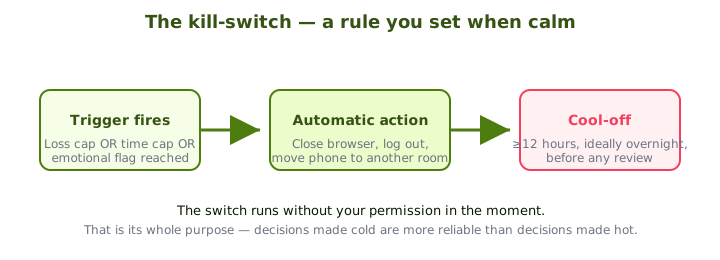
The kill-switch is a pre-committed automatic action that fires when any cap is broken. It is set up when calm, at the start of the month, and it is designed to run without your permission in the moment. Trigger → automatic action → cool-off.
Components of a functional kill-switch:
- Trigger: loss cap reached, time cap reached, or an internal signal (see next section on chase signals).
- Automatic action: close browser, log out of operator, move device out of arm's reach, walk away from the desk.
- Cool-off: minimum 12 hours before any review of the session, ideally overnight.
- Escalation: if the switch fires twice in a week, trigger a bank-side merchant-category block for the remainder of the month.
- Audit: log the trigger and the action in the weekly review.
Cool-off between sessions
Cool-off is the enforced gap between sessions. A minimum of 12 hours after any session, ideally overnight, is a defensible baseline for adults using non gamstop casinos as entertainment. Longer is better. Same-day return to play is a red flag under any discipline framework — it typically means the session that just ended did not really end.
Cool-off does not mean "waiting until you feel calm". It means an elapsed clock time regardless of how you feel. Feelings are unreliable inputs immediately after a losing session; they underweight the emotional cost of a further session and overweight the imagined recovery. The clock does not have those biases. Trust the clock.
A practical cool-off enforcement pattern: at the end of any session, set the phone alarm for 12 hours out with the label "cool-off ends". If it feels absurd to have to set an alarm for that, notice the reaction — it is a signal that the cool-off is exactly the discipline that would benefit you most. Structural rules exist for the moments willpower does not.
Cool-off is also the point in the cycle where audit happens most reliably. Once the 12 hours have passed and the emotional heat of the session has ebbed, you are able to look at the numbers honestly — the deposit, the withdrawal, the net position, the time elapsed. Do the log then, not in the moment. Logs written in the moment tend to be either bravado or self-recrimination; neither is useful data. A log written twelve hours later is a boring line in a spreadsheet, which is exactly what you want.
Externalising enforcement
The most reliable session limits are the ones you have externalised so they do not depend on you at all. Bank-side merchant-category blocks (Monzo, Starling, Barclays, Lloyds, NatWest, HSBC, Santander) sit at the top of this list — they turn on in under a minute, do not depend on operator cooperation, and impose a 24–72 hour cool-off on removal that outlives any single tired evening.
Other externalisation options include:
- Time-management browser extensions that lock a domain outside allowed hours.
- Router-level DNS blocks that make casino domains unreachable from the household network.
- Device-level parental controls used on your own device, with the passcode held by a partner.
- A partner or trusted friend holding a second-factor authenticator for the operator account.
- Physical separation of the play device from your usual working environment.
None of these are gimmicks; all of them work by adding friction between an impulse and a session. Friction is the enforcement mechanism. If you have designed your setup so that starting an impulse session requires ten minutes of unlocking and re-enabling, most impulse sessions will not happen. Related reading: our home page on non gamstop casinos and the long-form guides on bankroll management and budget tips.
A final observation on externalisation. The single strongest signal that a discipline framework is working is that it becomes boring to run. Boring means the caps are firing, the cool-offs are unremarkable, the audit shows a flat monthly pattern, and there is nothing to write in the notes column. If the discipline framework is producing drama — a top-up here, a rule bent there, an interesting story about the session — the framework is not working, whatever the numbers say at the end of the month. The right target is boredom. If you can produce that, you have arrived where the framework is trying to take you, and the rest is maintenance.
Frequently Asked Questions
What is a sensible session length?
For adults who choose to play at all, 45 to 60 minutes is the common upper end of a single session, with hard-stop enforcement. Some frameworks cap at 20 minutes. Longer sessions correlate with worse outcomes on average, regardless of cap size.
How many sessions per week is reasonable?
No more than two or three, with a minimum 12-hour cool-off between them. Daily play is a red flag under any discipline framework; if a habit has moved to daily, that is a signal to reduce or stop.
Do non-GamStop operators set session limits automatically?
Rarely. Some MGA-licensed operators offer voluntary reality-check pop-ups. Most Curaçao and Anjouan brands do not. Session limits at non-GamStop sites are self-imposed and self-enforced.
What is a reality check?
A reality check is a pop-up prompt that summarises time played and net position at intervals — usually every 15, 30 or 60 minutes. At UKGC operators these are commonplace. At non-GamStop operators they are patchy at best.
What is a loss cap versus a bankroll?
A loss cap is the maximum acceptable net loss for a single session — usually equal to the session bankroll. Hitting it is a hard stop, not a suggestion. The cap exists to enforce a specific behavioural rail; the bankroll defines the container from which the cap is drawn.
Should time or loss trigger the stop first?
Whichever fires first. Both are hard stops, treated identically. The one that fires more often is not a signal that the other cap can be relaxed.
Responsible Gambling
Please read this before applying any session-limit framework
Session limits are behavioural rails. They cannot compensate for a compulsion. If sessions are running past their caps repeatedly, if cool-off periods are being cut short, or if any of the chase signals from our home page apply to you personally, please speak to a professional.
Free UK services: GamCare National Gambling Helpline on 0808 8020 133, 24/7. NHS National Gambling Clinic via GP referral for structured treatment. GordonMoody for residential support. BeGambleAware for coordinating charity provision. GAM-Anon for family members. Statutory framing: Gambling Act 2005. Wider background at gov.uk and encyclopaedic reference at Wikipedia.
If you are currently GamStop-registered, please keep the registration in force. This page is a discipline framework for adults who are not self-excluded; it is not a workaround for those who are.

Nathan Cross
Bankroll Coach — CA Info
Nathan writes on bankroll and session control at online casinos — practical money-management for adults, with a consumer-warning lens on the friction non-UKGC sites create. Nothing on this page is legal, financial or medical advice.