
Bankroll defined precisely
A bankroll, in the context of non gamstop casinos, is a bounded, written, monthly-refreshed pot of discretionary money that a single adult has decided in advance they are willing to lose in full without any downstream consequence. Every clause in that sentence is load-bearing. Bounded — there is a specific number in pounds, not "a bit". Written — the number exists outside your head, on paper or in a spreadsheet, so you cannot rewrite it after a bad session. Monthly-refreshed — it aligns with your pay cycle and does not top up mid-cycle for any reason. Discretionary — it is drawn from money that is already surplus after essentials, savings and other planned spending. Willing to lose in full — this is the honest test: if losing the whole amount would produce anything more than mild irritation, the amount is too high.
Where this differs from a casual "budget" is precision. A budget is a plan. A bankroll is a container. A budget can flex; a bankroll cannot. Once the container is empty, the month is over, regardless of what the session-in-progress says or what the operator's next bonus offer says or what the day of the month is. The utility of a bankroll comes precisely from that inflexibility — it is a promise made when calm that the moment-in-time you cannot renegotiate.
At UKGC-licensed operators there is a shared safety net that partially catches players who over-run a self-imposed cap: affordability signals, deposit-limit tooling with enforcement, credit-card blocks, mandatory session prompts. At non gamstop casinos the safety net is either substantially weaker or absent. That is why bankroll definition matters more here — it is doing the work that was previously being done, in part, by the licensing regime.
Where the bankroll sits in your money hierarchy
Household finance can be organised into a hierarchy from most-protected to most-optional. At the base sit essentials — rent or mortgage, council tax, utilities, food, insurance, transport. Above that: debt repayment and savings contributions. Above that: discretionary spending — dining, leisure, hobbies, subscriptions. Any entertainment allocation to non gamstop casinos sits at the very top of that pyramid — inside the discretionary layer, and often the smallest sub-slice inside it.
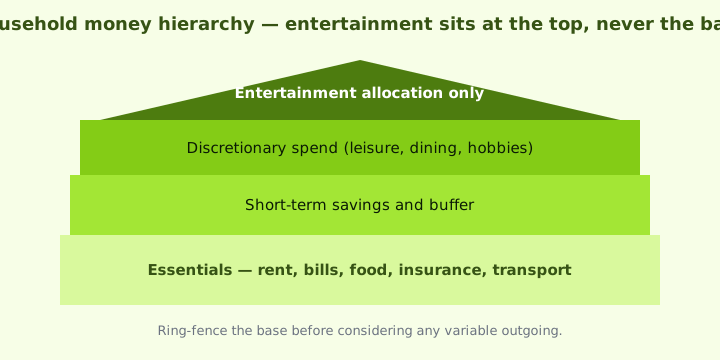
The two most common structural failures are inversion (an entertainment allocation eating into savings or essentials) and creep (the top slice quietly enlarging over successive months). Both are behavioural rather than mathematical problems, and both are best addressed with structural, non-willpower solutions: separate accounts, automated transfers on payday, and merchant-category blocks on the essentials card so it cannot be used for a top-up in a moment of weakness.
A practical arrangement adopted by many UK adults who choose to engage with this market at all: main current account for salary and direct debits, savings pot for auto-transferred goals, discretionary pot for leisure at large, and — if used at all — a small "play" pot that receives its monthly allocation on payday and never receives another transfer for the rest of the cycle. If the play pot is empty, the play does not happen. That is the entire enforcement mechanism, and it works precisely because it does not require any moment-in-time discipline.
The 1% rule in detail
The 1% rule is the most widely cited stake-sizing convention in bankroll writing. The rule states that any single stake should be no more than approximately one per cent of the session bankroll. If your session bankroll is £50, individual stakes stay at £0.50 or below. If your session bankroll is £120, individual stakes stay at £1.20 or below. The rule is deliberately conservative because its purpose is not to maximise return — nothing about it changes the house edge — but to keep the session alive long enough to actually experience the entertainment you have already paid for.
To see why 1% is a useful number, consider the arithmetic. A £50 bankroll staked at £5 per spin exposes ten per cent of the session pot to every independent event. Ten losing spins in a row on a game with realistic negative expected value — well within one-sigma variance for medium-volatility slots — closes the session in under a minute. Staked at £0.50, the same session survives ~100 spins on average, which is enough to actually experience wins along the way, and far more importantly, enough to give the kill-switch time to fire when the running total starts to look wrong.
The rule generalises. A £200 monthly bankroll broken into four £50 sessions, staked at 1%, is buying you four half-hour experiences at £0.50 a spin. A £200 monthly bankroll staked at £10 a spin buys you approximately six spins of experience, in exchange for a comparable expected value. Both scenarios lose the same money in expectation. Only one of them is actually entertainment.
Volatility-adjusted stakes
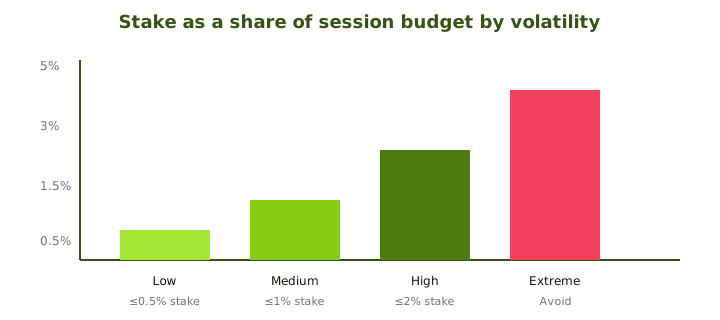
Volatility in a casino game is a measure of the spread of outcomes around the mean. Low-volatility games pay small amounts frequently and produce a narrower distribution. High-volatility games pay rarely, in larger amounts, and produce a much wider distribution. From a bankroll-survival standpoint the second category is markedly more dangerous. A high-volatility slot at the same 1% stake will burn through the session bankroll faster because the standard deviation of outcomes per spin is materially higher.
A workable adjustment framework:
- Low volatility — up to 1% of session bankroll per stake.
- Medium volatility — around 0.75% of session bankroll per stake.
- High volatility — 0.5% or lower per stake.
- Extreme volatility — outside the useful range of a discipline framework; better avoided.
The adjustment is heuristic, not scientific. Volatility ratings across operators are inconsistent; independent measurement is difficult; the maths of even a "medium" slot varies by title. The reason to keep the adjustment simple is that a rule that is complicated will not survive contact with a real session. A rule that fits on a Post-it note stuck to the monitor — "1% low, ¾% medium, ½% high, avoid extreme" — has a chance of being followed at 11pm on a Friday.
Buffer capital and drawdown
Even at 1% per stake, sessions lose. That is guaranteed on average, because negative expected value is the definition of a casino game. Buffer capital is the acknowledgement that the bankroll must be sized to survive a normal drawdown, not just the expected loss. A drawdown is the maximum peak-to-trough decline over a given period. In casino play, drawdowns of 30–60% of a session bankroll are common inside a single sitting on medium-volatility games, even at conservative stake sizes.
| Session bankroll | Stake at 1% | Approx. spins to variance-driven 50% drawdown (typical) | Comment |
|---|---|---|---|
| £20 | £0.20 | 25–60 | Small pot; single bad run ends it. |
| £50 | £0.50 | 60–140 | Median entry-level session. |
| £100 | £1.00 | 120–260 | Requires longer time budget. |
| £250 | £2.50 | 300–620 | Rarely worth playing to the end. |
The middle column is a rough guide, not a promise. The point is that a drawdown of half the session bankroll is not a signal to top up — it is well within normal variance. Topping up transforms one session's normal variance into two sessions' worth of losses. The buffer belongs inside the session bankroll from the start; it is not additional capital to be produced when needed.
Refresh cadence and rollovers
Bankrolls refresh monthly, aligned with pay cycle. That cadence is deliberate — it forces a full month between decisions and lines up with the psychological cadence of household budgeting. Weekly refresh sounds attractive because it lowers the individual amount, but it produces four decision points per month rather than one, and every additional decision point is another chance for the rule to bend.
Rollovers — carrying unused balance forward — sound harmless and are not. The temptation to combine, say, three lightly-used monthly bankrolls into one larger session is exactly the mechanism that produces the sessions people later regret. Unused balance at the end of a month goes back into general discretionary funds or into savings; it does not stack. If you consistently under-use the monthly cap, the honest response is to reduce the cap for the following month, not to save up for a bigger sitting.
How to treat winnings
Winnings should be withdrawn immediately. Not reinvested, not left on the account as "playing money", not treated as belonging to the bankroll. The moment a payable balance exists, it becomes an ordinary withdrawal request. That is the discipline. Reasons:
- Left on the account, a winning balance is exposed to the same house edge on the next spin as any fresh deposit. Reinvestment is loss-in-waiting.
- Withdrawn immediately, winnings restore some fraction of the session's entertainment cost. Left on the account, they do not.
- Withdrawal triggers KYC at most non-GamStop operators — typically at withdrawal rather than deposit. Doing that early clears the friction before it becomes a problem.
- Realising winnings as withdrawal, not balance, keeps the ledger honest for the weekly audit.
This is a discipline point, not a strategy claim. Withdrawing does not improve expected value on future sessions. It does, however, prevent the psychological trick where a temporarily higher balance produces a temporarily larger stake, and then — one variance-driven correction later — a session loss that is materially larger than any single loss the plan actually authorised.
Weekly audit habit
The bankroll only works if it is reviewed. A weekly audit — pick a day, pick a time, treat it as fixed — records: sessions played this week, total time, total deposit, total withdrawal, running balance for the month, notes on any rule breach (even a small one). The audit is honest, boring, and short. A five-minute review on a Sunday evening keeps the whole system operating; without it, the monthly cap becomes a memory rather than a fact.
An honest audit will occasionally record a rule breach. That is fine, and expected. What matters is what happens next. A small breach recorded once is a data point; a small breach recorded three consecutive weeks is a pattern, and a pattern is a signal that the framework needs to change — usually toward a smaller cap, or toward switching the play pot off entirely. If the audit is inconvenient, that is a signal that the play is not producing the value the framework assumes it is; a hobby you cannot bear to look at honestly is not a hobby.
Failure modes to recognise early
Every discipline framework has predictable failure modes. Naming them in advance makes them recognisable in the moment.
- Cap creep — the monthly amount rises slowly across quarters. Compare month twelve to month one honestly.
- Session extension — "just five more minutes" turning into "just five more sessions".
- Silent top-up — a fresh deposit inside the month that the audit did not capture.
- Rollover consolidation — combining months in the hope of a "proper session".
- Winnings retention — a payable balance treated as "not real money" and re-staked.
- Off-platform gambling — moving to a second operator to escape a self-imposed limit at the first.
- Bankroll concealment — hiding an account or a session from a partner.
Any single one of these appearing recurrently is a signal. Two of them appearing in the same month is a hard stop. The correct response is not a revised bankroll — it is a professional conversation, and the resource text-mentions in the responsible-gambling section below list the free UK services that exist for exactly that conversation.
Frequently Asked Questions
How much bankroll do I need to play a session?
There is no minimum — the correct answer is often zero. If you choose to play, a widely used rule of thumb is a session bankroll of 100–200 times your intended average stake for medium-volatility play, so the session survives its own variance.
Does the 1% rule work on high-volatility slots?
Only as a starting point. High-volatility games need smaller stakes as a share of session bankroll — often 0.5% or less — because the wider variance chews through the budget faster.
Is bankroll management the same as advantage play?
No. Bankroll management does not change the house edge. It is a stake-sizing and session-discipline framework designed to control how quickly discretionary money is spent, not to overcome the mathematical edge of the game.
How often should the bankroll refresh?
Monthly is the standard cadence, aligned with pay cycles. Never top up mid-cycle, and never borrow forward from next month. Both defeat the point of the container.
Should winnings be added to the bankroll?
No. Winnings should be withdrawn immediately and treated as returned entertainment spend, not as an increase to future exposure. Rolling winnings into the bankroll is a slower version of loss chasing.
Do non-GamStop operators run affordability checks?
Not to the UKGC standard. Some MGA-licensed brands have modest checks; most Curaçao and Anjouan operators do not perform proactive affordability review. That is the core structural risk of the market.
Responsible Gambling
Please read this before applying any framework from this page
Bankroll management is a discipline tool. It has limits. If your play is producing anything other than mild entertainment — chasing losses, hiding sessions, borrowing, missed commitments, mood alteration — the correct next step is a conversation with a professional, not a refined spreadsheet.
Free UK services (text mentions only): GamCare on 0808 8020 133 for the National Gambling Helpline, 24/7. NHS National Gambling Clinic via GP referral for structured treatment. GordonMoody for residential support. BeGambleAware for coordinating charity work. GAM-Anon for affected family and partners. For statutory framing see the Gambling Act 2005, general government resources at gov.uk, and encyclopaedic background on problem gambling.

Nathan Cross
Bankroll Coach — CA Info
Nathan writes on bankroll and session control at online casinos — practical money-management for adults, with a consumer-warning lens on the friction non-UKGC sites create. He is not a financial adviser and nothing here is personalised advice.