
The envelope method in plain English
The envelope method is one of the oldest and most reliable household-budgeting techniques on record. The mechanism is simple: on payday, cash is divided into physical envelopes labelled by category — rent, food, transport, utilities, savings, and so on — and when an envelope is empty for the month, the category is closed until the next pay cycle. It works because it externalises willpower. You do not have to remember not to spend from the "food" envelope on entertainment; the envelope is either full or empty and the question answers itself.
Applied to non gamstop casinos, the envelope method translates one-to-one. Each category becomes a pot or a separate account. On payday, money moves. If an envelope labelled "play" exists at all, it receives a small fixed allocation and never receives another transfer for the rest of the month. If the envelope is empty, the play does not happen. That is the entire enforcement mechanism.
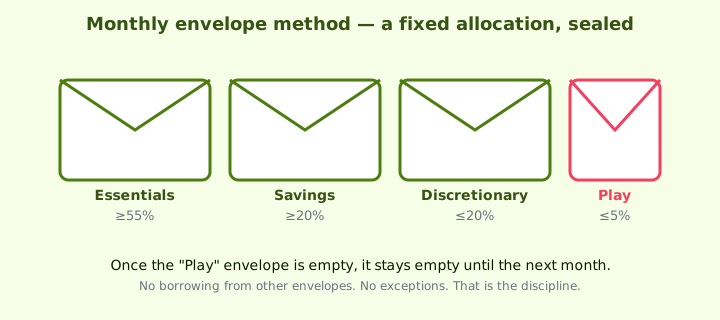
The reason the envelope method matters for offshore play specifically is that offshore operators will not enforce the empty envelope for you. UKGC-licensed operators are increasingly obliged to raise checks as a customer's monthly spend rises. Non-GamStop operators run on a different licence framework and — with a few MGA exceptions — do not do this proactively. The envelope has to hold on its own, without any operator cooperation.
Two clarifications are worth making at the outset. First, the envelope method does not care about the specific brand of bank you use — the mechanism is generic, and it can be implemented with cash tins on a shelf, sub-pots inside a challenger bank, or discrete accounts across two high-street banks. What matters is separation, not brand. Second, envelopes only work if the transfers are automatic. A manual monthly ritual "on payday" that requires you to remember to move the money is going to fail on the third month. Set the transfers up once, standing order or scheduled sweep, and let them run.
Expense-first budgeting
Expense-first budgeting inverts the more common income-first approach. Rather than start with income and figure out what you can spend, expense-first starts with everything you must pay — rent or mortgage, council tax, utilities, insurance, food, transport, debt repayment, savings target, essential subscriptions — and treats those as fixed. Anything left is discretionary; entertainment allocation is a sub-slice of the discretionary residual.
Two features make this order-of-operations useful for anyone considering non gamstop casinos. First, it makes it structurally impossible to plan around a shortfall — essentials are calculated first, so if the residual is thin, that is the actual answer and no amount of optimism is going to enlarge it. Second, it removes the psychological trick where a bonus or overtime payment gets mentally earmarked as "extra to play with"; expense-first treats every incremental pound the same, meaning it goes through the essential-first hierarchy every time.
- List all essentials line by line for a typical month.
- Add fixed savings contributions and debt repayments as if they are non-negotiable bills.
- Subtract the total from net take-home pay.
- The residual is the total discretionary pool for the month.
- Split discretionary into meaningful categories (leisure, dining, hobbies, gifts, small purchases).
- If a play envelope exists at all, size it at the low end of the discretionary sub-slices.
- Automate transfers on payday so all envelopes fill in a single action.
Entertainment-only allocation
The play envelope is entertainment allocation. Not investment, not income supplement, not "opportunity". The mental frame matters because it fixes the expected value of the activity in advance. If the money in the envelope is entertainment spend, the honest expectation is that the envelope will empty over the course of the month, occasionally with a small refund via a lucky session, but structurally negative in aggregate. That is the correct expectation. Any expectation that the envelope will grow, or even hold, is a category error.
The comparison to make is with any other paid entertainment. A monthly streaming subscription empties. A restaurant bill empties. A concert ticket empties. Nobody expects those categories to produce income; they produce a specific experience, and the money buying the experience is gone. The play envelope, if used at all, should be sized as if it were a subscription — a fixed monthly cost for a specific entertainment, and no more.
Setting the monthly cap
The monthly cap is the size of the play envelope. There is no universal correct figure. There is, however, an honest test: at the end of a month in which the entire cap is lost, does anything change about your life? If the answer is anything other than "no, I am mildly disappointed", the cap is too high.
| Illustrative net income (£/month) | Essentials + savings estimate | Discretionary residual | Illustrative play envelope cap |
|---|---|---|---|
| 1,800 | 1,650 | 150 | 0–15 |
| 2,400 | 2,100 | 300 | 0–30 |
| 3,200 | 2,720 | 480 | 0–48 |
| 4,200 | 3,450 | 750 | 0–75 |
| 5,500+ | varies | varies | Cap should sit below other hobbies |
The zero column exists deliberately. For a significant share of adults, the correct cap is zero — no play envelope at all — and that is not failure, it is prudence. The table is illustrative and does not constitute personal financial advice.
Cap-sizing is where most budgets go wrong. A common failure pattern is to set the cap at the top of the discretionary residual, on the theory that "any money left after essentials is fair game". That theory ignores the other legitimate discretionary categories — books, dining out, gifts, a modest coffee habit, a weekly cinema trip, an annual holiday fund — that also live in the same residual. When the play envelope claims most of the residual, the other categories quietly get squeezed. The right test is not "how big can it be", it is "what does everything else in my life cost, and what is left after that". If the answer is a small number, the cap is a small number. Growing it to feel less small is exactly the behavioural trap the envelope method exists to avoid.
Another common failure is quarterly re-basing — a small cap creeping upward every three months on the theory that "if I could handle £30 last quarter, I can handle £45 this quarter". Bankroll and budget caps should trend downward over time, not upward, because the discipline is easier at lower caps and the downside of an unfortunate month is smaller. If you find yourself talking yourself into a bigger cap, that instinct is itself a signal to hold or reduce.
Handling irregular income
Freelance, self-employed, gig-economy and commission-based earners have a specific problem: months vary, sometimes substantially. The right way to handle this is to base entertainment allocation on the lowest three months of the trailing twelve, not on the average and definitely not on the best month. The play envelope should survive a bad month, not be swollen by a good one.
An additional discipline for irregular earners is a stabilisation pot — a savings envelope that receives excess in good months and refills the essentials envelope during lean ones. Entertainment allocation, if used at all, comes strictly after the stabilisation pot has hit its target for the month. Below-target months mean no play envelope for that cycle. This is the honest version of "cutting your cloth to fit".
Digital pots as envelopes
Physical cash envelopes are impractical for online use, but the mechanism translates directly to digital pots. Monzo, Starling, Chase and Revolut all offer named pots with programmable auto-transfers on payday. NatWest, Lloyds and Barclays offer similar features under different branding. The essential characteristics of a functional digital envelope are: a distinct visible balance, an auto-transfer on payday, and — critically — a card that is not saved in any browser or digital wallet.
- Distinct balance: the pot must appear as its own line item, not as a virtual subdivision of the main balance.
- Auto-transfer on payday: the allocation must happen without a manual step so it does not compete with willpower.
- Card not saved anywhere: the friction of typing card details is one of the most effective structural discipline tools available online.
- Merchant category blocks on other cards: the primary current-account card should have the gambling MCC blocked so an "accidental" top-up is not possible.
- Distinct card colour or design where offered: visible signals help.
Bank-side merchant-category blocks are the highest-leverage structural intervention available to a UK adult in this market. They turn on in under a minute, require a 24–72 hour cool-off to remove, and do not depend on operator cooperation. If you are trying to control exposure to non gamstop casinos, the block is where the highest-value action sits — often above and before any budget discipline on the envelope side.
The monthly review cycle
Budgets that are set and not reviewed drift. A structured monthly review — pick a date, treat it as fixed — reads the previous month's actuals against the plan, notes any envelope that ran short or ran over, and adjusts the coming month's caps up or down. The review is short, honest, and unavoidable. Ten minutes on the first Sunday of the month is enough.
The review must be honest about the play envelope specifically. If it needed a top-up, that fact goes into the record. If a top-up happened outside the envelope — from savings, from an unallocated bonus, from a credit card — that fact goes into the record too. The purpose is not to punish; the purpose is data. Three consecutive months of top-ups is a signal to close the envelope, not to increase it.
Two additional habits make the monthly review reliable. First, keep the review in a place a partner or trusted person can see, if that is workable in your household — accountability is not shame, it is a structural aid. Second, keep the review numerically honest by working from bank exports rather than memory. Memory rounds down losses and rounds up wins. The bank export does neither. A ten-minute reconciliation of the exported statement against the discipline plan is worth more than an hour of self-narration.
Budget red flags to notice early
Certain patterns in a review record are structural warning signals, and naming them in advance makes them recognisable:
- The play envelope has needed a top-up in two of the last three months.
- An "unallocated" income item (bonus, tax refund, gift) went straight into play.
- Essentials are being paid partly on credit.
- Savings contributions have been paused for reasons that trace back to play.
- A partner or family member has asked about spending.
- Play sessions are being hidden or under-reported in the audit.
Any single one appearing recurrently is a signal to shrink the envelope. Two or more appearing simultaneously is a signal to close it and speak to one of the services named in the responsible-gambling section below. Budgeting cannot fix a problem it is not sized to fix; if you have hit that level, the correct response is help, not a refined spreadsheet.
The single most useful mental model here is the smoke-alarm analogy. A smoke alarm sounds long before the fire is dangerous, precisely so there is time to act. The red flags above are the smoke alarm; they exist to be noticed early, when the response is small — reduce the cap, take a month off, speak to a partner. If you wait until the response has to be large, you have waited too long. The whole point of budgeting is early intervention against structural risk; late intervention is the opposite discipline and it belongs to a different profession.
Frequently Asked Questions
Is the envelope method compatible with online play?
Yes. Digital pots in Monzo or Starling, or a separate current account in another bank, function as digital envelopes. The mechanism — a physically separate container of money — works identically online and offline.
What if my income is irregular?
Base the allocation on the lowest three months of the trailing year, not the average. Entertainment allocation should survive a bad month, not just a good one. Freelance and self-employed adults tend to under-cap in this respect.
Should the play envelope come before or after savings?
After — always. Savings and emergency-fund contributions are non-negotiable. Entertainment allocation is the residual, not a priority category. Reversing the order is the most common budgeting error at this end of household finance.
Can I borrow from the discretionary envelope to top up play?
No. Cross-envelope borrowing defeats the entire discipline. If the play envelope is empty, the month is over. Any borrowing pattern is a signal to shrink or close the play envelope entirely.
How do I hide the play envelope from myself outside sessions?
Use a pot in a challenger bank you do not check daily, or a separate account in a different bank whose card is not saved in any browser or wallet. Friction is the enforcement mechanism.
Is the entertainment allocation taxable income?
No. UK gambling winnings are not subject to income tax for individuals, and money you allocate to entertainment is money you have already paid tax on through PAYE or self-assessment. This is a budgeting question, not a tax question.
Responsible Gambling
Please read this before drafting any budget on this page's model
A budget cannot make an unsafe activity safe. If any of the red flags above apply to you personally, please speak to a professional. The free UK services are:
GamCare National Gambling Helpline on 0808 8020 133, 24/7. NHS National Gambling Clinic via GP referral. GordonMoody for residential and intensive support. BeGambleAware for coordinating charity provision. GAM-Anon for affected family and partners. Statutory background: Gambling Act 2005 and the general government resource site at gov.uk. Wider consumer-protection research is published by the OECD.
If you are registered with GamStop, please keep the registration in force. This page is not a workaround for self-exclusion; it is a discipline framework for adults who are not self-excluded.

Nathan Cross
Bankroll Coach — CA Info
Nathan writes on bankroll and session control at online casinos — practical money-management for adults, with a consumer-warning lens on the friction non-UKGC sites create. His writing is general and not personalised financial advice.